
Reduce Windsor business insurance costs by up to 50%. Discover verified strategies: policy bundling, CFIB discounts, risk recategorization, and annual payment savings.
Strategy Summary
Quick Summary for Busy Business Owners
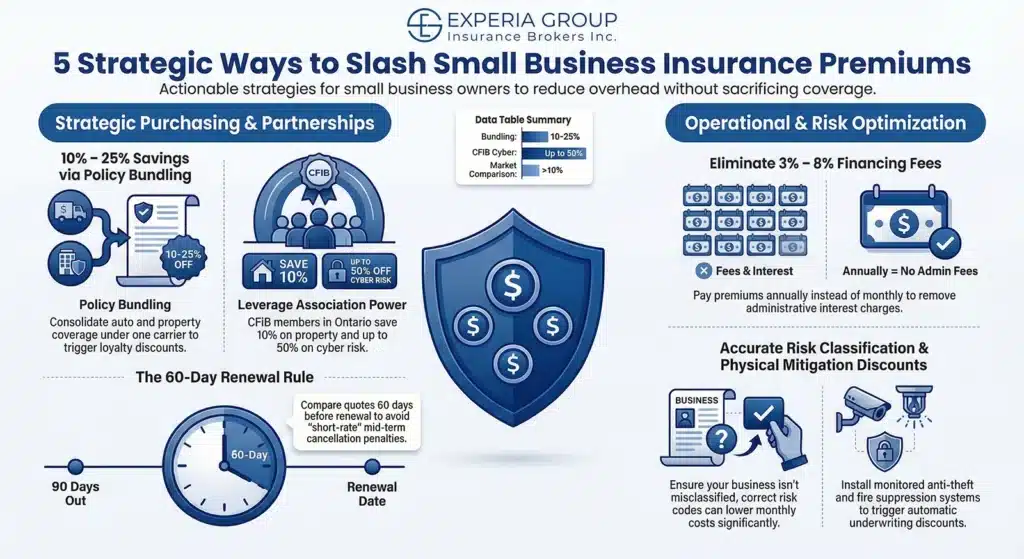
- Leverage Policy Bundling: Combine auto and property coverage to secure premium reductions of 10%–25%.
- Utilize Association Discounts: CFIB members in Ontario can save 10% on property and up to 50% on cyber risk.
- Optimize Payment Terms: Paying annually eliminates financing fees, immediately lowering total overhead.
1. Strategic Policy Bundling for Instant Reductions
For Windsor business owners, the most immediate lever to pull for premium reduction is the consolidation of insurance policies. Insurers favour clients with multiple lines of business, often rewarding this loyalty with significant rate reductions. Rather than fragmenting coverage across different providers for general liability, commercial property, and commercial auto, consolidating them under one roof streamlines administration and cuts costs.
The Financial Impact of Bundling
Data indicates that the savings from this strategy are not marginal. At Experia, we see that businesses that bundle policies—such as combining commercial auto and property insurance—can see premium reductions ranging from 10% to 25%. This percentage is substantial when applied to the operational overhead of a growing enterprise.
- Reduced Administrative Burden: Managing a single renewal date reduces the risk of lapsed coverage.
- Higher Client Priority: Insurers are statistically less likely to drop clients with multiple tied policies during risk reviews.
- Gap Elimination: A single carrier managing both liability and property is less likely to dispute which policy covers a specific claim (e.g., a vehicle damaging a loading dock).
By unifying these policies, Windsor businesses stop paying full retail price for fragmented services and leverage their total purchasing power.
2. Capitalizing on Association Memberships and Affinity Groups
Many small businesses in Windsor leave money on the table by failing to leverage their memberships in professional organizations. Insurance carriers often negotiate group rates with associations because the collective risk pool is viewed as more stable and professional.
CFIB and Professional Savings
The Canadian Federation of Independent Business (CFIB) offers some of the most aggressive discounts in the market. Research highlights that:
- General Savings: A standard CFIB membership allows businesses to save 10% on commercial property and casualty insurance, as noted by the CFIB.
- Cyber Risk Reductions: For digital protection, industry reports confirm that CFIB members in Ontario can access savings of up to 50% on cyber risk coverage.
Affinity Group Leverage
Beyond the CFIB, businesses should audit their affiliations with alumni networks or industry-specific guilds. Market analysis confirms that associations and affinity groups can offer group rates that are significantly lower than standard market rates. These programs are designed to reward the specialized nature of professional groups, often providing coverage enhancements that are unavailable to the general public.
3. Audit Risk Categories and Implement Physical Mitigation
Insurance premiums are calculated based on risk codes. If a business is misclassified, the owner pays for risk exposure they do not actually have. For example, a contracting business focused on interior finishing should not be rated at the same risk level as a structural roofing company.
Accurate Classification Matters
Ensuring your business operations are accurately described to the underwriter is critical. Underwriting guidelines dictate that for construction and contracting businesses, premiums can range widely—from $60 to $250 per month—depending entirely on the accurate categorization of risk. A lower risk class code directly correlates to a lower monthly premium.
Physical Risk Mitigation Discounts
Insurers also reward proactive safety measures. Installing verified hardware demonstrates a commitment to loss prevention. Standard underwriting practices typically reward specific safety features with targeted discounts. Key installations include:
- Monitored Anti-Theft Devices: Reduces burglary and theft premiums.
- Fire Suppression Systems: Approved sprinkler systems and fire alarms lower property damage risk.
- Cyber Security Protocols: Multi-factor authentication can sometimes assist in qualifying for better cyber rates.
Regularly updating the insurer on these upgrades ensures the premium reflects the current, safer state of the business.
4. Competitive Market Shopping and Strategic Renewal Timing
Loyalty penalties are real in the insurance industry. Businesses that auto-renew without reviewing the market often face creeping rate increases. A proactive approach involves aggressive comparison shopping and careful timing of vendor switches.
The Value of Comparison
Competition forces insurers to sharpen their pricing. CanadianSME reports that comparing quotes when insurers compete for risk can lead to rate reductions of more than 10%. Furthermore, market research highlights that basic liability coverage in Ontario can start as low as $500/year, but this floor is typically only found by those who actively shop around.
Timing the Switch
When switching providers to capture these lower rates, timing is non-negotiable. Canceling a policy mid-term often incurs a “short-rate” cancellation penalty, which can negate potential savings. FSRAO advises waiting until the renewal date to switch providers to avoid these mid-term cancellation penalties. Smart business owners align their market research 60 days prior to renewal to ensure a seamless transition without fees.
5. Elimination of Financing Fees via Annual Payments
Cash flow management often dictates monthly payments, but this convenience comes at a premium. Most insurance carriers charge a financing fee (ranging from 3% to over 8%) for the administrative cost of processing monthly withdrawals.
The Annual Payment Advantage
Transitioning to an annual payment structure is a guaranteed return on investment. We always emphasize that paying premiums annually instead of monthly eliminates these financing fees entirely, lowering the overall cost of the policy.
- Instant ROI: Saving 4-8% on financing fees is often a better return than leaving that cash in a low-interest operating account.
- Simplified Accounting: One invoice per year reduces bookkeeping entries and the risk of missed payments causing policy cancellation.
For Windsor businesses with sufficient working capital, this is the simplest administrative change to permanently lower insurance costs.
Maximizing Profitability Through Risk Management
Lowering small business insurance rates in Windsor is not about cutting corners on coverage; it is about optimizing how that coverage is purchased and structured. By bundling policies, leveraging association strength, and timing renewals effectively, businesses can reclaim thousands of dollars in annual overhead.
- Audit: Review current policies for bundling opportunities immediately.
- Join: Verify eligibility for CFIB or alumni affinity rates.
- Schedule: Mark the renewal calendar 60 days out to begin market comparisons.
Insurance is a necessary expense, but paying retail price is a choice. Execute these steps to transform a fixed cost into a managed asset.
Final Thoughts
Lower insurance costs don’t come from shortcuts or underinsuring your business. They come from understanding how insurers assess risk, making informed coverage decisions, and reviewing insurance regularly as your business changes.
For Windsor small business owners, this approach can lead to meaningful savings over time without sacrificing protection. If you’re unsure whether you’re overpaying or whether your coverage still reflects your current operations, book a meeting with one of our knowledgeable advisors to get help with your small business insurance.